Meridian Rail Systems: the maintenance monopoly nobody indexed
An illustrative Open Coverage teardown of a hypothetical under-covered short-line rail supplier — used to exercise the research format end to end.
Transparency: AI-assisted, human-edited. Read our policy.
Disclaimer: Not financial advice. Research and educational purposes only.
Research ID: RES-2026-001 | Status: on_track
Investment Thesis
Meridian's recurring maintenance contracts and regulatory lock-in are underpriced by a market that has no analyst covering the short-line rail supply niche; re-rating hinges on the coverage gap closing, not on the freight cycle.
Catalyst: First initiation of analyst coverage or a small-cap index inclusion would force a re-rate of the recurring-revenue base.
This is an illustrative, hypothetical example used to validate the publishing pipeline. Meridian Rail Systems is fictional. Nothing here is investment advice.
Wall Street does not look at Meridian Rail Systems. The company is small, the sector reads as boring, and the business — maintaining track for short-line freight operators — is easy to misfile as a pure freight-cycle play. That misfiling is the whole story.
Coverage Gap
There is no sell-side analyst covering MRDN [FMP] 0 estimates . The reason it is invisible tells you what the market is missing: it is uncovered because it looks cyclical, not because it is small. Screeners bin it with industrials that swing with freight volume, so nobody prices the recurring, regulation-mandated maintenance contracts underneath.
Business
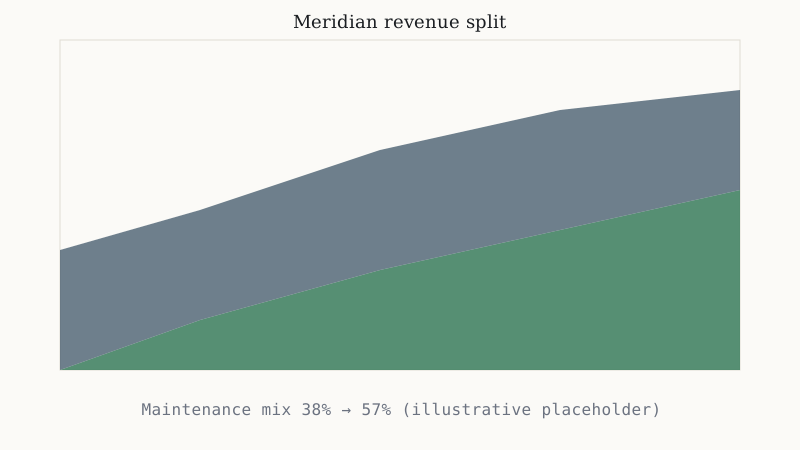
Meridian earns roughly 57% of revenue from multi-year maintenance contracts and the remainder from one-off track rebuilds. The contract book is the part the freight-cycle framing ignores.
Moat / Mispricing
The edge is a switching cost dressed as red tape: crews must hold FRA certification per operator territory [SEC] 10-K Item 1 , and re-certifying a new vendor costs an operator more than it saves. If that certification lock-in holds, an 11x multiple is a cyclical multiple on a recurring-revenue business.
Capital Allocation
ROIC has expanded four years running as management reinvests into certification coverage rather than chasing rebuild volume [FMP] ROIC 14.2% .
Risks
The thesis breaks if a well-capitalized competitor absorbs the certification cost to buy share, or if a freight downturn stalls the rebuild segment long enough to mask the maintenance base. Two of my recurring blind spots apply here: I tend to underweight how fast an entrant can undercut a switching-cost moat, and I lean optimistic on the addressable market of a niche this small.
Valuation
At 11x earnings the market is paying for a cyclical rebuilder. If the maintenance mix is durable, that is the wrong comp set — the recurring base deserves a services multiple, not an industrials one.
Re-rating Catalyst
The coverage gap is the catalyst. First analyst initiation or a SmallCap 600 inclusion would force the market to price the contract book explicitly, rather than by cyclical analogy.
Thesis
See the finalized thesis above. It is my judgment, signed off against the numbers; AI drafted and helped verify, but the call is mine.
Never Miss an Update
Get our latest research and post-mortems delivered straight to your inbox.
Subscribe Now